
Power and Gold in in ancient Colombia
The Beyond El Dorado exhibition was held in 2013 at the British Museum. It was the first exhibition I actually attended of it’s sort and was completely mesmerised on what was on display.
There were 300 artefacts on show. Below I narrowed down to 6 of my standouts. Although there were plenty more, it seems the collage options back in 2013 only allowed single digit images!
The exhibition focused on 6 civilisations; Quimbaya, Tolima, Tairona, Zenu, Muisca & Calima chosen by Museo del Oro, Banco de la Republica, Colombia. The artefacts were purposely combined with gold, copper & natural occurring silver to symbolise a microcosmos. What I love is how gold was not seen as currency to pre-Hispanic civilisations but a material of great symbolic and spiritual meaning.
We may know El Dorado as a mythical city made of gold that tantalised and confounded early European explorers of South America. But in fact it translates as ‘the gilded one’. Ancient civilisations would throw gold offerings for their gods into Lake Guatavita. When a new ruler came to power they would symbolically turn themselves into an offering by covering their body in gold dust and sailing into the lake. Conquistadors heard tales of this and effectively convinced themselves that, as people had that much gold to spare, they must have made a city out of it.
The exhibition titled as ‘Beyond El Dorado’ was an interesting take. It emulates beyond what the term has come to mean, and also into a past long before Europeans imposed their myths upon South America. The older pieces in this exhibition could have been made 3000 years before the conquest.
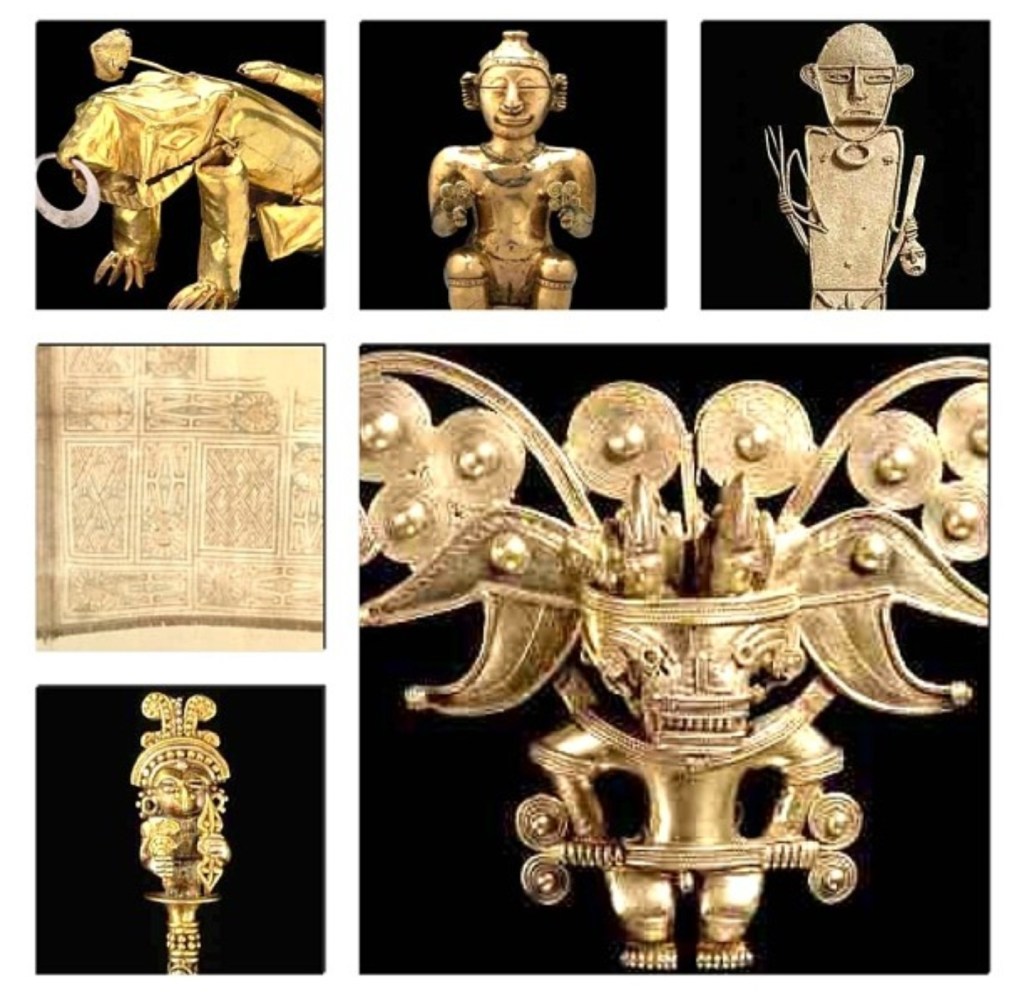
- The revered Jaguar with a platinum nose ring (top left). 2. A painted cotton textile from Muisca people which was wrapped around a mummy (centre left). 3. A dipping pin of a warrior pectoral (bottom left). 4. Female figure from Quimbaya culture to store lime powder, used when chewing coca (top centre). 5. Tunjo figurine offered to the gods (top right). 6. Anthropomorphic bat pectoral (bottom).
 Jasmin Journal